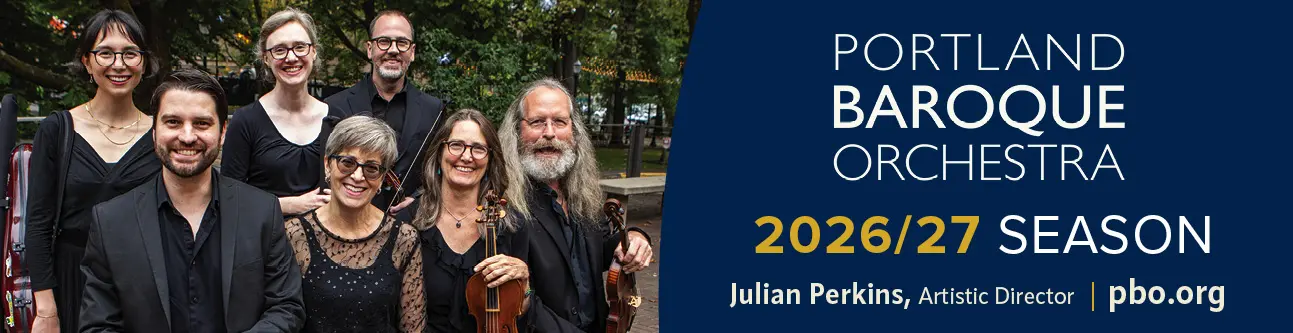
Pulling Out All the Stops: Julian Perkins Previews PBO’s 2026/27 Season
Virtuosic strings, wind trio sonatas, a Bach family program, and English viols take center stage this year. Julian shares what he’s most looking forward to.
Portland Baroque Orchestra’s 2026/27 season opens this October, and Artistic Director Julian Perkins has built it around a simple idea: great music connects us across time and place, and the differences between composers are often as rewarding as the similarities.
The season spans repertoire from early 17th-century London to Moravian chamber music of the 1790s. It opens with virtuosic string concertos in Art of the Violin (October 10 & 11), followed by Winds of Fortune (October 17), which puts oboe, recorder, bassoon, and harpsichord in the spotlight. Later programs include The Bach Dynasty, which sets J. S. Bach alongside his sons, and a program celebrating American-born composer John Antes. The Players’ Podium series continues with principal cellist Joanna Blendulf’s program of English viol music, and the season closes with Mozart and Boccherini.
In this Q&A, Julian talks about how the season took shape, what he hopes audiences will take away from each program, and what he’s most looking forward to hearing live.
Q: Julian, we are all excited to see what is in store for this season. I know you spoke about “contrast and connection” as the season’s throughline — how did that idea first take shape when you sat down to plan 2026/27?
Julian: I started with the idea of “mentors and rivals.” In life, those two roles often overlap; teachers often become (friendly) rivals as their former students develop their own voices. This idea soon morphed into “contrast and connection” as we broadened this concept to embrace repertoire dating from London in the early 1600s to Moravian chamber works composed during the last decade of the eighteenth century. It’s inspiring how the arts defy borders and time frames to connect us across the centuries. We hope to share a taste of this during our imminent season.
Q: This season you are placing a lot of focus on specific sections of the orchestra; what do you think the audience will get from these programs that highlight different instruments?
J: For me, focusing on specific sections of the orchestra is somewhat akin to pulling out individual stops on a world-class organ. Given that PBO’s experienced musicians are as much soloists as they are chamber music players, it seemed only natural to devise some programs that spotlight different groups of instrumentalists. Opening our season with virtuosic string concertos, followed closely by a program that includes trio sonatas for wind instruments, will hopefully display something of the group’s impressive sonic scope.
Q: “Winds of Fortune” pulls oboe, recorder, bassoon, and harpsichord into the spotlight — instruments that don’t always lead. Are there unique challenges or opportunities you are looking forward to for this concert?
J: Inter alia, I’m fascinated to see how the recorder and bassoon interact in Vivaldi’s Trio Sonata in A Minor. Each instrument is quite distinct, yet Vivaldi writes virtuosic, chordal patterns for them that one usually associates with the violin. Moreover, in Telemann’s Trio Sonata in C Minor, the oboe and recorder face the additional challenge of navigating very similar ranges. I can’t wait to hear how the players reconcile their competing differences – or will they?
Q: “The Bach Dynasty” program in November puts J. S. Bach’s sons right alongside him. What do you want audiences to walk away thinking about that generational contrast between the Bachs?
J: In short, utter amazement at how a single family could produce so much musical brilliance over just two generations.
I often wonder what breakfast was like chez Bach. It was presumably a rushed affair. Let’s imagine Bach senior sipping his cinnamon-spiced coffee (then popular in Leipzig) while teasing C. P. E. about his penchant for writing fashionable “galant” music with its light, open textures and frequent sighing motifs. Where was the contrapuntal fiber that he had fed his son throughout childhood with his course of Inventions, Sinfonias and Preludes and Fugues?!
We want our audience to savor this extraordinary family’s significant musical differences – as well as their occasional similarities.
Q: “American Baroque: Haydn’s Moravian Connection” program centers John Antes, a name most audiences won’t know. What made his story worth building a program around?
J: I’m fascinated by John Antes’s life; born in Pennsylvania, he probably met Franz Josef Haydn, composed his string trios in Egypt, made string instruments, and retired to Bristol, England. What is his artistic identity, and how does his music differ from that of his European counterparts?
As an Englishman, I’m always wanting to know more about the rich musical traditions in the US and celebrate them with our audiences.
Q: The Player’s Podium series hands programming over to individual players. What have you learned from letting musicians curate that you’ve carried into your own programming?
J: I love how these podiums both help to broaden our repertoire and enable the players to take ownership of a program. As you know, the last Podium saw our principal bassoonist, Nate Helgeson, explore the delicious soundscape of two bassoons, two gambas, theorbo, and harpsichord with works by the likes of Boismortier, Forqueray, Marais, and Rameau. It’s heartening how receptive the audience was to this French repertoire given that it is often less familiar nowadays.
We are indulging in an equally luscious soundworld this season. Our principal cellist, Joanna Blendulf, will explore lesser-known English gems by Purcell and his contemporaries with a line-up of tenor and bass viols, violas, violins, violone, theorbo, organ, and harpsichord. Yum!
Q: The All Ages Concert draws on the same English consort repertoire as the February subscription program. What’s it like translating that material for a completely different audience?
J: Obviously, it’s vital never to “dumb down” music for any audience. In fact, some of those who attend our All Ages concert bring fresh perspectives to the music that I may not have considered.
Our goal at these events is to provide a relatable context for the music and explain why we play it the way we do with a series of compare-and-contrast snippets. Think of it like a gourmet tasting menu: we offer bite-sized musical morsels before performing the occasional movement in full. In this way, we hope to whet musical appetites.
Q: By March, the season turns toward Bach’s Ich habe genug — a meditation on death described as “a peaceful homecoming.” That’s a heavier emotional turn. How did you build toward that moment?
J: In March, nature (hopefully) undergoes a vibrant rebirth as winter yields to spring – as evident in Portland’s abundant cherry blossoms. As a Lutheran, Bach regarded death as a joyful rebirth in Christ. So it seems fitting to meditate upon an inescapable fact of life during the Lenten season, when the Christian church prepares for Easter.
Q: Countertenor Tai Oney returns for this program. What is it about his voice that made you want to pair him with the oboe and bring him in as soloist for Ich habe genug?
J: I loved collaborating with Tai when he joined us for Pergolesi’s Stabat Mater with soprano Anna Dennis at the end of our 2025 season. Like the players, Tai is both a team player and a soloist, blending with the instruments at one moment before taking center stage the next. This flexibility is crucial for Ich habe genug, where the oboe acts in some ways as the singer’s alter ego.
Q: The season closes with Mozart’s Eine kleine Nachtmusik — a very familiar piece to most of our audience. Is this a piece you’ve played and programmed many times before, and how do you frame it up for the season finale to get your desired effect?
J: Mozart’s Eine kleine Nachtmusik has lived with me ever since I played the violin at school. The challenge for us performers is to maintain a fresh relationship with such familiar pieces, so it never seems as if we’re reheating an old meal. I’m inspired here by those actors and singers on Broadway who perform the same show eight times a week over an extended period. They never sound stale.
In terms of framing Mozart’s “night music”, I couldn’t resist pairing it with Boccherini’s La Musica Notturna delle strade di Madrid with its vivid depictions of church bells and military drums. In Boccherini’s minuet, the cellists are even instructed to place their instruments on their knees and strum them like guitars to evoke strolling street musicians.
Q: If you had to pick one piece from this entire season that you’re most looking forward to hearing live, what would it be — and why?
J: As a shameless musical chameleon, my view is that the piece I most love hearing live is whichever one I’m experiencing at that moment! So I do hope our beloved patrons revel in the moment with me!
Season subscriptions and single tickets are available for all of our concerts. Join us and experience so many great music moments this season.