In conversation with Malcolm Bruno
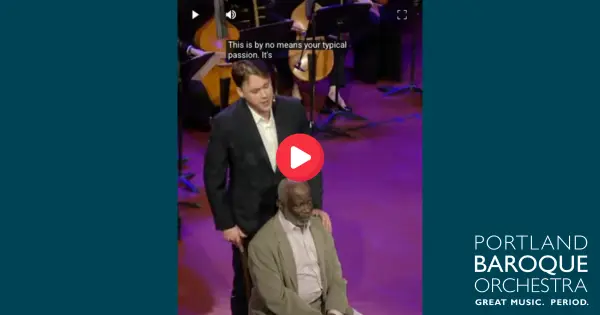
Julian Perkins talks with Malcolm Bruno ahead of PBO’s performance of his reconstruction of Bach’s Markus Passion on July 12. This forms part of a tour in collaboration with the Oregon Bach Festival and Concert Theatre Works. Featuring famed actor Joseph Marcell in the spoken role of Evangelist, this passion is lean and mean – just four singers, single strings, and winds. A “Pocket Passion”, you could say.
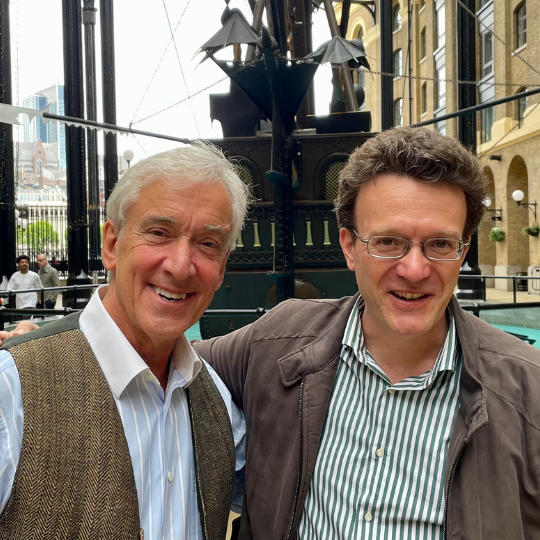
JP: For centuries, Johann Sebastian Bach’s St. Matthew Passion and St. John Passion have stood as pillars of sacred music, performed and revered worldwide. But what about this other Passion – the one that nearly vanished into obscurity?
MB: The annual Good Friday Passion was a fixture of Bach’s Leipzig liturgical year. The first performance of the St. John Passion in 1724, Bach’s first year at Leipzig, set the stage for his other Passions, particularly and for Bach’s dramatic talent generally, as the city authorities forbade the Thomaskirche cantor to indulge in the writing of opera.
JP: The Markus Passion is a fascinating work that you have recently pieced together and brought back to life. Can you tell us more about this?
MB: Bach performed Passions by other composers as well as his own, encompassing all four versions of the Passion story (one for each gospel). His great St. Matthew Passion, using double choir, was first performed in 1727, while the St. John was given at least four times during Bach’s lifetime. The Bach Passion archives also include a St. Luke Passion, which Bach copied but did not himself compose, as well as a reference to a St. Mark Passion composed by him and first performed in 1731. This work was, however, lost between Bach’s death in 1750 and the publication of his complete works, begun a century later, in 1850.
Since the late nineteenth century scholars have been almost unanimous in agreeing that this St. Mark Passion was largely a recycling of music from a funeral ode which Bach had previously composed, in 1727, in celebration of the life of his Patron’s wife, the Electress of Saxony. The earlier work is, however, conspicuously shorter than the St. Mark Passion, whose libretto has survived independently without music. The tantalising task for anybody wanting to reconstruct this lost masterpiece is thus how to restore it without overwhelming those genuine if skeletal movements that remain. Based on this funeral ode, the St. Mark, unlike Bach’s other, very public Passions, retains the private, personal character of the work from which it originated. Indeed, it is one of the most intimate of Bach’s public works.
JP: Now, a groundbreaking production of this overlooked masterpiece is making its way from the UK to the US, forging powerful partnerships with early music organizations across the country. Because each leg of the tour has a different director, do you think each audience will get something unique from it?
MB: Bach’s creativity, like Shakespeare’s, reaches far beyond any single realisation, any single period’s performing traditions. As its editor and reconstructor I rejoice that some of the finest advocates of baroque music in America will be exploring my realisation. I look forward this year to performances in New York and Pittsburgh and on the west coast in Eugene, Portland, and Seattle, as well as in Aldeburgh and Edinburgh in the UK. They will each have their distinctive character, of course.
JP: Bringing this lost work back to life is more than an academic exercise: it’s an act of cultural rediscovery. At a time when audiences crave both tradition and innovation, your version of the St. Mark Passion offers a fresh yet historically grounded experience. It invites us to rethink what we know about Bach’s musical world and to consider how forgotten works can find new resonance in modern times.
MB: For me, aside from the joy of stepping into an imagined landscape of Bach’s Passions, the chance to hear an actor cast as the Evangelist is very special and powerful for contemporary audiences. As all of Bach’s music for the sung part of the role of the Evangelist in this Passion is lost, the challenge for an editor is how to restore and integrate this essential biblical text, which tells the dramatic story of the final days and hours of Jesus’s life. I have turned away from composing pastiche because I believe that option takes us too far from Bach’s music and imagination. There are also actors replacing what would have been the vocal soloists for Bach’s original ‘crowd choir’. Each actor has one foot firmly planted in Bach’s original St. Mark Passion, but the other in our world. They speak to us in our own language, as if the Passion is happening now rather than within the liturgy of eighteenth-century Leipzig, and so they liberate the music. It becomes more direct and powerful, freed from the world of German Pietism.
The English text, which I commissioned from Jessica Gordon, consciously avoids the archaic grandeur of the King James Bible while remaining elevated from everyday language, a poetic contemporary/twentieth-century English, from the world of a Yeats or an Eliot or a Woolf. And as the Passion story proceeds, an actor such as Joseph Marcell compels us to ask ourselves whether this is a play come musical with music by Bach or a Passion by Bach moved from pulpit to stage. The synergy of classical actor and fine consort singers gives us a new and, I hope, compelling way into this unknown Passion.
-Text edited by Stephen Pettitt
EVENT:
Markus Passion
July 12, 2025 | 7:00 PM
First United Methodist Church
1838 SW Jefferson St
Portland, OR 97201
WATCH: Julian Perkins’ introduction to Markus Passion